How “Vibe Coding” Actually Works — And How You Can Build One
We’re entering a new era where AI doesn’t just assist developers — it co-develops alongside them. Vibe Coding platforms represent that shift: collaborative, real-time, AI-augmented environments that merge coding, context, and execution into a single seamless flow.
Here’s what makes it tick 🔧👇
1. The Frontend Experience
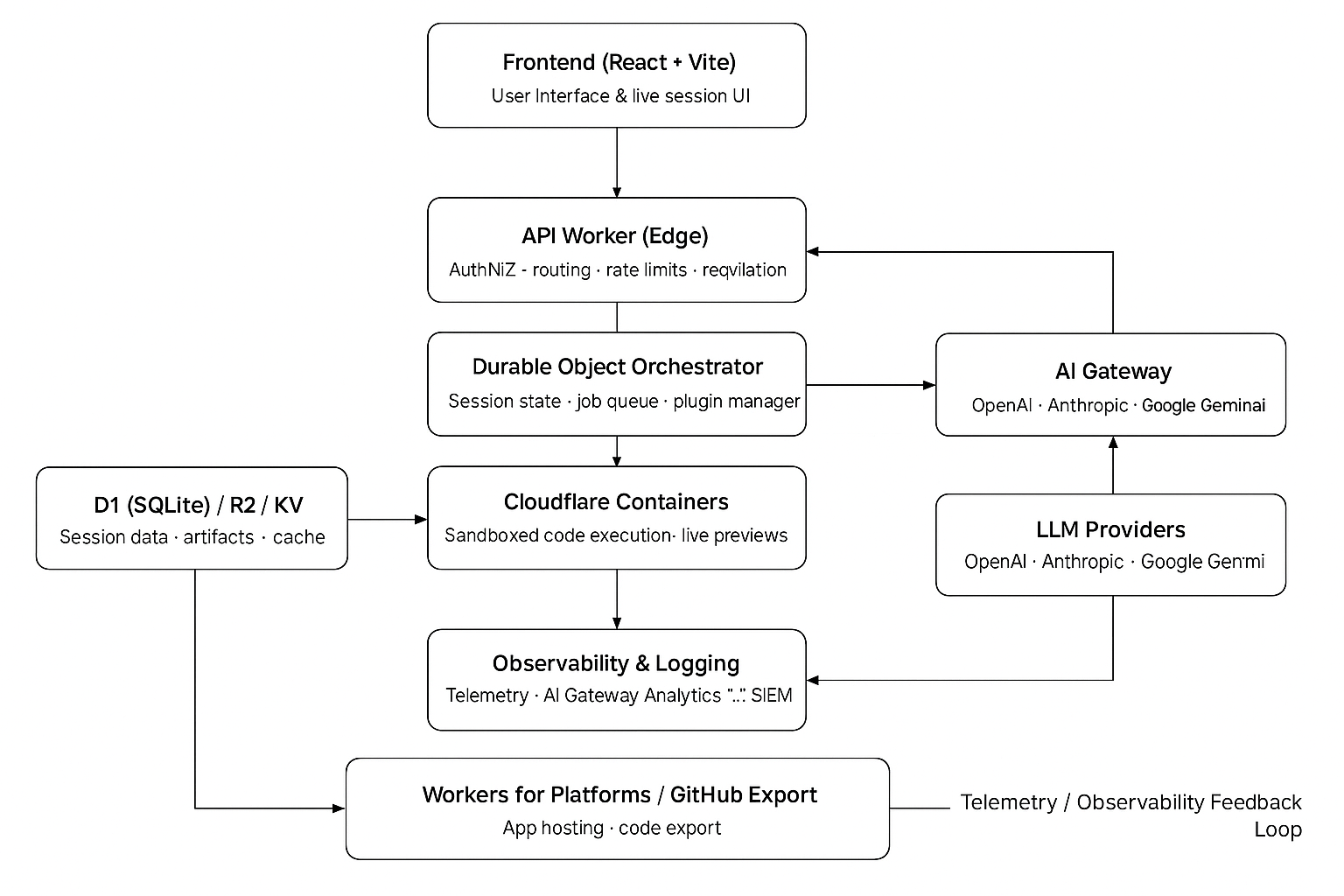
The interface (typically built with React + Vite) provides live, synchronized editing sessions. It’s lightweight, reactive, and wired for WebSocket or durable object sessions that keep multiple users in sync with low latency.
2. Edge-Orchestrated Intelligence
Every request passes through Edge Workers that handle authentication, rate limiting, and request validation — before hitting the Durable Object Orchestrator.
This orchestrator acts as the session brain: managing plugin lifecycles, state persistence, and AI task queues at the edge for real-time responsiveness.
3. Compute & Execution Layer
User code runs in Cloudflare Containers — sandboxed, isolated environments for safe preview and execution.
These environments connect to data stores like D1 (SQLite), R2, or KV for caching, session data, and artifact persistence.
4. The AI Gateway
The orchestrator communicates through an AI Gateway that routes requests intelligently across providers like OpenAI, Anthropic, and Google Gemini — based on latency, token pricing, and capability matching.
It’s not just model selection — it’s context-aware routing.
5. Observability & Feedback
Every interaction is logged through Telemetry & SIEM pipelines, feeding analytics back to Observability & Logging services.
This creates a feedback loop for continuous optimization — code performance, AI response quality, and cost profiling.
Want to Build One?
You can prototype a simplified Vibe Coding platform with:
Frontend: React + Vite + WebSocket or Durable Objects
Edge Layer: Cloudflare Workers for API & Auth
Compute: Cloudflare Containers or Deno Deploy
AI Routing: Serverless gateway for OpenAI / Anthropic APIs
Data: D1 (SQLite) for session state and KV for cache
Observability: Wrangler logs + Sentry or Grafana for telemetry
The secret sauce is edge-native orchestration — bringing compute, context, and collaboration closer to the user, not the data center..
#VibeCoding #AIEngineering #DevSecOps #Cloudflare #EdgeComputing #OpenAI #Anthropic #SoftwareArchitecture #RealtimeCollaboration #LLM